Virtual CFO · Startup Finance
Virtual CFO for Startups in India: When You Need One and What It Costs
Most founders don't need a full-time CFO. Most founders also can't run a fundraise, a board, and monthly cash flow off a spreadsheet and gut feel forever. Here is where the line actually falls, and what it costs to cross it.
Quick answer
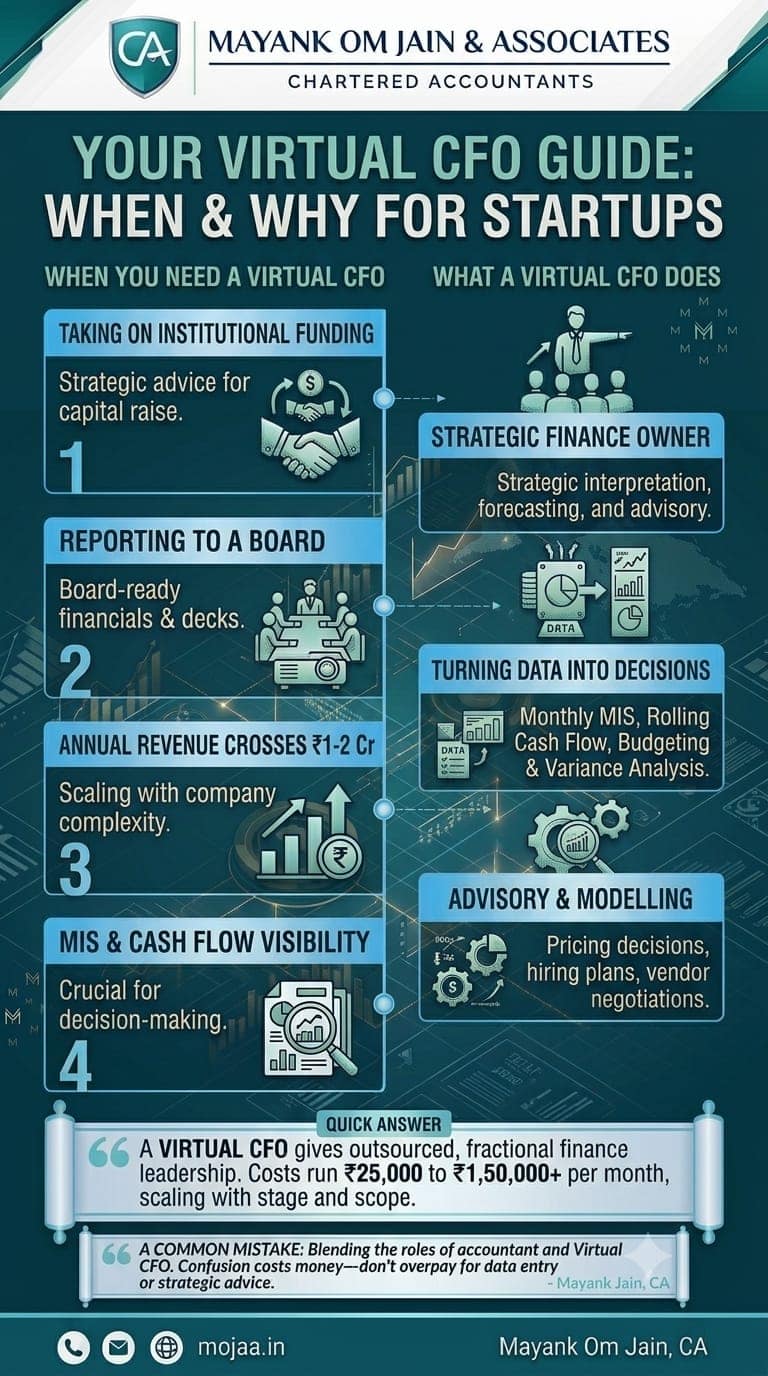
A Virtual CFO is an outsourced, fractional finance leader who gives an Indian startup MIS reporting, cash flow visibility, budgeting, and investor-ready financials without the fixed cost of a full-time hire. Most startups need one once they take on institutional funding, start reporting to a board, or cross roughly ₹1–2 Cr in annual revenue. Typical engagements in India run ₹25,000 to ₹1,50,000+ per month, scaling with company stage and scope.
Summary
- A Virtual CFO owns strategic finance (reporting, cash flow, budgeting, fundraise readiness), not bookkeeping or GST filing, which stays with your accountant.
- There's a real trigger point for hiring one: institutional funding, a board, or revenue complexity, not "as soon as you can afford it."
- Cost scales with engagement depth, roughly ₹25,000 to ₹1,50,000+ a month in India, and is still a fraction of a full-time CFO's fixed salary and equity.
What does a Virtual CFO actually do for a startup?
The core of the role is turning raw transaction data into decisions a founder can act on. In practice, that means monthly MIS reports that show not just what happened but why margins moved; a rolling cash flow forecast that flags a runway problem eight weeks before it becomes a crisis, not eight days; budgeting and variance analysis that catches a department overspending in month two instead of month eleven; and board-ready decks that translate the month's numbers into the three things a board actually needs to know.
A good Virtual CFO also sits in on pricing decisions, hiring plans, and vendor negotiations, not to approve them, but to model the cash and margin impact before the founder commits. That advisory layer is the actual differentiator between a Virtual CFO and a more senior accountant: one reports the past accurately, the other uses the same numbers to shape what happens next.
How is a Virtual CFO different from an accountant or a bookkeeper?
These three roles get blended together constantly, and the confusion costs founders money: either they overpay a bookkeeper for strategic advice they're not equipped to give, or they underpay a Virtual CFO to do data entry that should sit elsewhere.
| Role | What they own |
|---|---|
| Bookkeeper | Day-to-day transaction entry, invoicing, expense recording: the raw data layer |
| Accountant / CA (compliance) | Statutory filings (GST, TDS, ITR, ROC compliance), accuracy and deadlines |
| Virtual CFO | Strategic interpretation of that data: reporting, cash flow, budgeting, fundraise and board support, decision modelling |
A Virtual CFO typically works on top of the bookkeeping and compliance layer, not instead of it. If those foundational functions are messy, the Virtual CFO's first job is usually to fix the pipeline before any strategic reporting can be trusted.
When does a startup actually need a Virtual CFO?
There is no universal revenue number that triggers this. It's driven by complexity and external accountability, not size alone. Four situations reliably create the need:
Investors expect regular, structured MIS and board reporting. Producing that from scratch every month without a dedicated owner is where founders lose the most time relative to value created.
Clean historicals, a defensible cap table, and realistic projections are the backbone of diligence. Retrofitting this after a term sheet lands is slower and riskier than building it in advance.
Below this, most founders can reasonably track cash in their head. Above it, with multiple revenue lines, vendors, and payroll cycles, gut-feel tracking starts producing real blind spots.
Once someone outside the founding team has a formal right to financial information on a schedule, informal reporting stops being sufficient, structurally and, in many cases, contractually.
How much does a Virtual CFO cost in India?
Pricing scales with engagement depth rather than company size alone. As a rough guide for the Indian market:
| Engagement level | Typical scope | Indicative monthly cost |
|---|---|---|
| Light / early-stage | Monthly MIS, basic cash flow tracking, a few hours a month | ₹25,000 – ₹50,000 |
| Standard / growth-stage | Full MIS, budgeting, board decks, weekly touchpoints | ₹50,000 – ₹1,00,000 |
| Intensive / fundraise or scale-up | Investor data room, projections, due diligence support, near-daily availability | ₹1,00,000 – ₹1,50,000+ |
Even at the top end, this remains a fraction of a full-time CFO's fixed cost once salary, benefits, and any equity are accounted for, which is exactly why the fractional model exists for companies not yet at the scale that justifies a full-time hire.
What should you look for before hiring a Virtual CFO?
Sector experience matters less than most founders assume; financial fundamentals transfer across industries. What matters more: has this person actually sat through a fundraise or a board cycle before, not just prepared reports for one? Do they have a defined monthly deliverable and cadence, or is the engagement open-ended and vague? Are they independent of your bookkeeping and audit function, so there's a natural check rather than one person marking their own homework? And critically, will they tell you an uncomfortable number in month one, or will the first red flag only surface once it's unavoidable?
How does a Virtual CFO engagement typically work month to month?
Most engagements run on a recurring cycle: books are closed and reconciled early in the month, MIS and cash flow reports go out by a fixed date, a review call walks the founder through what moved and why, and any board or investor materials are prepared ahead of scheduled updates. Ad hoc work (modelling a new hire's cost impact, reviewing a vendor contract, prepping for an investor call) sits on top of that base cadence. The first one to two months are typically setup: understanding the business, cleaning up historical data, and establishing the reporting structure, before the engagement shifts into steady-state advisory work.
Notes on edge cases
- Solo founders
- A solo founder without any finance hire yet can still benefit from a light Virtual CFO engagement (often just a monthly review call and a simple cash flow tracker) mainly to build reporting discipline early, before complexity makes it harder to retrofit. The scope here is usually the lightest tier, not the standard package.
- Pre-revenue startups
- Before revenue, the priority shifts from MIS to burn-rate discipline and runway modelling: how many months of cash remain at current spend, and how that changes under different hiring or spending scenarios. A full Virtual CFO engagement is often premature here; many pre-revenue founders are better served by a narrower runway-and-budgeting engagement until revenue and complexity justify the fuller scope.
- Bootstrapped startups with no plans to raise
- Without investor reporting as a forcing function, the case for a Virtual CFO rests on internal decision quality (pricing, unit economics, and cash discipline) rather than external accountability. This is a legitimate reason to hire one, but the engagement should be scoped around the founder's actual decisions, not a generic investor-facing template.
- Multi-entity or holding company structures
- Startups operating through more than one legal entity (a holding company and an operating subsidiary, or separate entities per geography) need a Virtual CFO who can consolidate reporting across entities and flag inter-company transactions correctly, which is materially more complex than single-entity MIS and should be priced and scoped accordingly.
- Seasonal or cash-flow-volatile businesses
- For businesses with sharp seasonal swings (certain D2C, agri-linked, or event-driven models) the standard monthly cadence may not be tight enough. These businesses often need weekly, not monthly, cash flow tracking during peak volatility windows, even if the broader engagement otherwise sits at a lighter tier.
Frequently asked questions
Is a Virtual CFO the same as a full-time CFO, just part-time?
The scope is similar (reporting, cash flow, budgeting, board and investor support) but the engagement model differs. A Virtual CFO works fractionally, often across a few client companies, giving comparable strategic input at a fraction of the fixed cost.
How many hours a month does a Virtual CFO typically work with a startup?
It scales with stage. An early-stage startup with simple operations might need 8 to 15 hours a month. A funded startup preparing for a raise or managing a board might need several days a month, especially around closing periods.
Can a Virtual CFO work with a startup that has no finance team at all?
Yes, this is a common starting point. They work directly with the founder and a bookkeeper, building the reporting structure from scratch, and typically help design and hire the in-house team as the company grows.
Do I need a Virtual CFO before or after raising funding?
Ideally before, or at the very start. Investors expect clean MIS and realistic projections during diligence. Bringing one on only after a term sheet is signed means retrofitting reporting discipline under time pressure.
What's a realistic minimum contract length for a Virtual CFO engagement?
Most substantive engagements run three to six months minimum, since it takes one or two reporting cycles to properly diagnose the financial structure. The first month or two is largely setup, not strategic input.
Can a Virtual CFO also help during fundraising and due diligence?
Yes, one of the most common reasons startups bring one on. They typically prepare the data room, review projections, clean up the cap table, and handle finance-side diligence questions alongside legal counsel.
Sources: the firm's Virtual CFO and startup advisory observations across 200+ engagements. Pricing bands are indicative market ranges for the Indian startup ecosystem and vary by scope, sector, and stage. This article is for general awareness and is not a substitute for advice on your specific situation.