Shareholders' Agreement · Fundraising
Tag Along Rights: What Every Startup Founder Must Know Before Signing an SHA
If Tag Along is missing from your SHA, an early investor or ESOP holder can be left behind the moment you sell. Here is what the clause actually does, and how to draft it in.
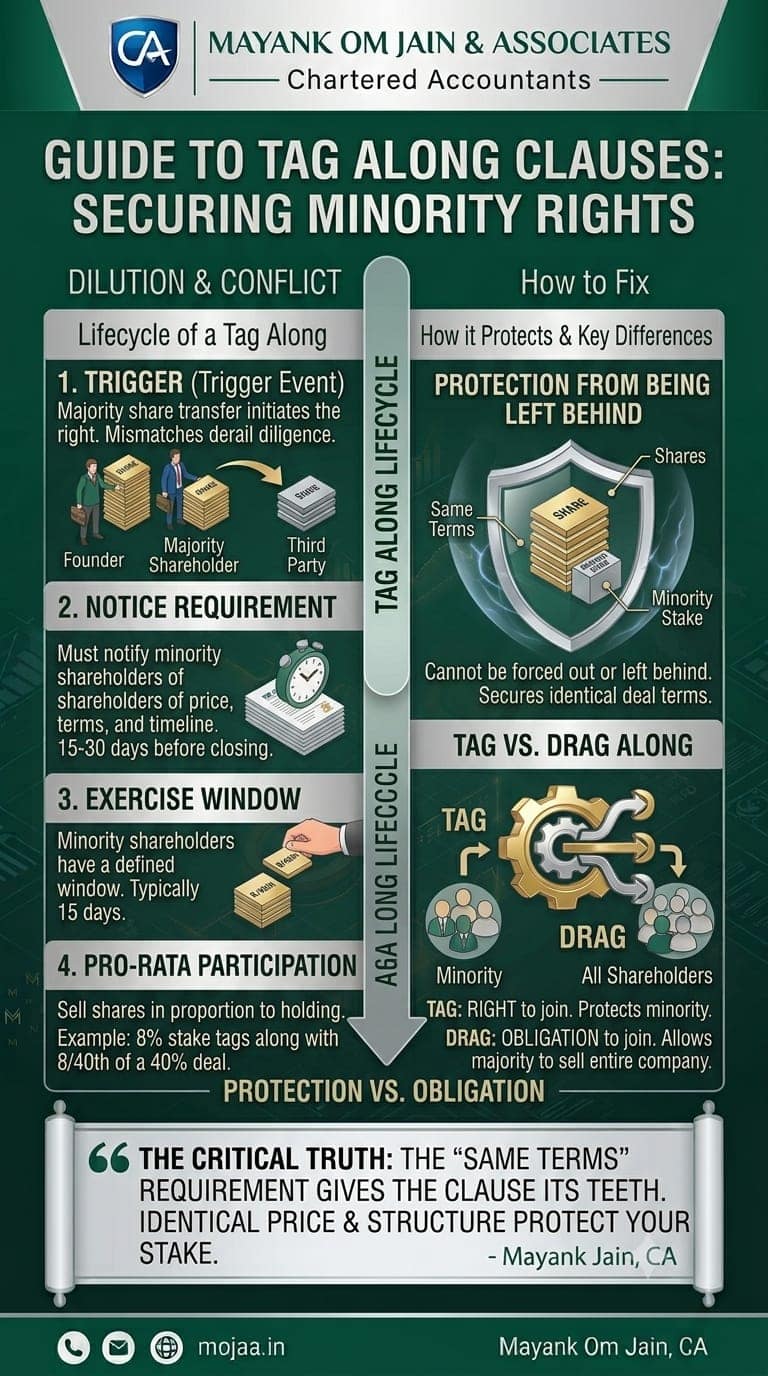
Quick answer
Tag along rights (also called co-sale rights) let minority shareholders join a transaction when a majority shareholder sells their stake. If a founder sells shares to an investor or acquirer, a minority shareholder with tag along rights can require their shares to be included in the same deal, at the same price and terms. They cannot be forced out or left behind.
Summary
- Tag along protects minority shareholders: it lets them join a sale a majority shareholder is already making, on identical terms.
- It is not automatic. Many early-stage SHAs simply omit the clause, leaving early investors and ESOP holders exposed.
- The clause runs on four moving parts: a trigger event, a notice period, an exercise window, and same-terms, pro-rata participation.
Why do tag along rights matter for a minority shareholder?
Imagine an angel investor holds 8% of your company. As founder, you decide to sell 40% to a strategic buyer at ₹500 per share. Without a tag along clause, the angel investor has no automatic right to join that sale. The buyer may not want a minority shareholder in the cap table at all, and the angel is simply left holding a stake in a company they no longer have influence over. With tag along rights in place, the angel investor can require you to include their shares in the same deal, at the same ₹500 per share.
How does a tag along clause work in practice?
A standard tag along clause in an SHA runs on four components:
| Component | What it defines |
|---|---|
| Trigger | A proposed transfer of shares by a founder or majority shareholder to a third party |
| Notice requirement | The seller must notify minority shareholders of price, terms, and timeline, typically 15 to 30 days before closing |
| Exercise window | Minority shareholders get a defined window, usually 15 days, to elect to participate |
| Pro-rata participation | A minority shareholder can sell in proportion to their holding: 8% of the company can tag along with 8/40th of a 40% deal |
The "same terms" requirement is what gives the clause its teeth: same price per share, same payment structure, same closing date. The minority shareholder cannot be offered inferior terms just because their stake is smaller.
How is tag along different from drag along?
These two clauses are commonly confused, and they protect opposite parties.
Protects minority shareholders. They can choose to join a sale the majority is already making, and they cannot be left behind.
Protects majority shareholders and acquirers. If a majority of shareholders approve a sale, minority shareholders can be forced to sell alongside them, on the same terms.
Both clauses are standard in a well-drafted SHA, and they work together: drag along gives an acquirer certainty they can buy 100% of the company; tag along gives minority holders certainty they won't be excluded from a good exit.
How do you add tag along rights to an SHA?
- Define the trigger eventSpecify exactly what kind of transfer activates the right, for example, any founder sale above a set percentage of total shares.
- Set the notice requirementRequire the selling shareholder to notify minority shareholders of price, terms, and timeline, typically 15 to 30 days before closing.
- Define the exercise windowGive minority shareholders a fixed window, usually 15 days from notice, to elect whether they will participate.
- Specify pro-rata participationState that a participating shareholder can sell in proportion to their existing holding relative to the total shares in the deal.
- Lock in same-terms languageMake clear that tagging shareholders get the same price, payment structure, and closing date, with no carve-outs.
- Review and executeCheck the clause against existing share classes and, for any non-resident shareholders, against FEMA pricing guidelines, then have it signed as part of the SHA by all parties.
Notes on edge cases
- Drag along overriding tag along
- If a deal is structured as a drag along sale (majority forcing a 100% exit), tag along becomes irrelevant for that transaction: minority shareholders are already required to sell on the same terms drag along guarantees. The two clauses interact but don't stack; check which one actually governs a given transaction.
- Tag along without a matching drag along
- An SHA with tag along but no drag along can make a full acquisition harder to close, since an acquirer cannot force out a holdout minority shareholder who refuses to sell even on identical terms. Founders negotiating an SHA should generally push for both clauses together, not one in isolation.
- Non-resident shareholders and FEMA pricing
- Where a tagging shareholder is a non-resident (NRI or foreign investor), the transfer price must also satisfy FEMA pricing guidelines for transfer of shares, not only the SHA's same-terms requirement. A price that is contractually valid under the SHA can still require RBI-compliant valuation support before the transfer can be reported and completed.
- ESOP holders who haven't exercised
- Tag along rights attach to shares, not to options. An employee holding unexercised ESOPs is not yet a shareholder and typically has no tag along right until exercise, unless the ESOP scheme itself provides for accelerated exercise on a change-of-control event, which is worth checking separately from the SHA.
- Multiple share classes (CCPS vs equity)
- If the SHA's tag along clause is drafted only for equity shares, holders of Compulsorily Convertible Preference Shares (CCPS) may find themselves excluded from a founder sale entirely. Confirm the clause explicitly covers every class of security the company has issued, not just ordinary equity.
Frequently asked questions
Does every SHA automatically include tag along rights?
No. Many early-stage SHAs, especially those drafted quickly around a small angel round, skip tag along entirely. It has to be negotiated and drafted in explicitly.
What ownership percentage triggers tag along rights?
There is no fixed statutory percentage. The SHA itself defines the trigger threshold, so this needs to be checked clause by clause rather than assumed.
Can a founder sell shares without triggering tag along?
Yes, if the sale falls below the SHA's trigger threshold, or the transfer type is expressly excluded, such as a transfer to an affiliate or family trust.
What happens if a minority shareholder misses the exercise window?
The right lapses for that transaction. Once the window closes without an election to participate, the seller can proceed without including the minority shareholder's shares.
Do ESOP holders get tag along rights?
Only once options are exercised into actual shares, and only if the SHA or a deed of adherence extends the right to that share class.
Is a 15-day notice period standard for tag along clauses?
It's the generally recommended minimum, not a legal requirement. SHAs can specify a shorter or longer period, but under 15 days leaves little real time to decide and arrange financing.
Sources: Standard Indian venture SHA drafting practice; Companies Act, 2013 share transfer provisions; FEMA (Non-Debt Instruments) Rules, 2019, pricing guidelines for share transfers involving non-residents. This article is for general awareness and is not a substitute for advice on your specific situation.