FEMA · NRI Advisory
FEMA Compliance for NRIs in India: Bank Accounts, Property, and Remittance Rules
Most NRIs manage their India finances on Income Tax logic. FEMA is a separate law, with its own residency test, its own account rules, and its own remittance limits, and it doesn't wait for you to notice the difference.
Quick answer
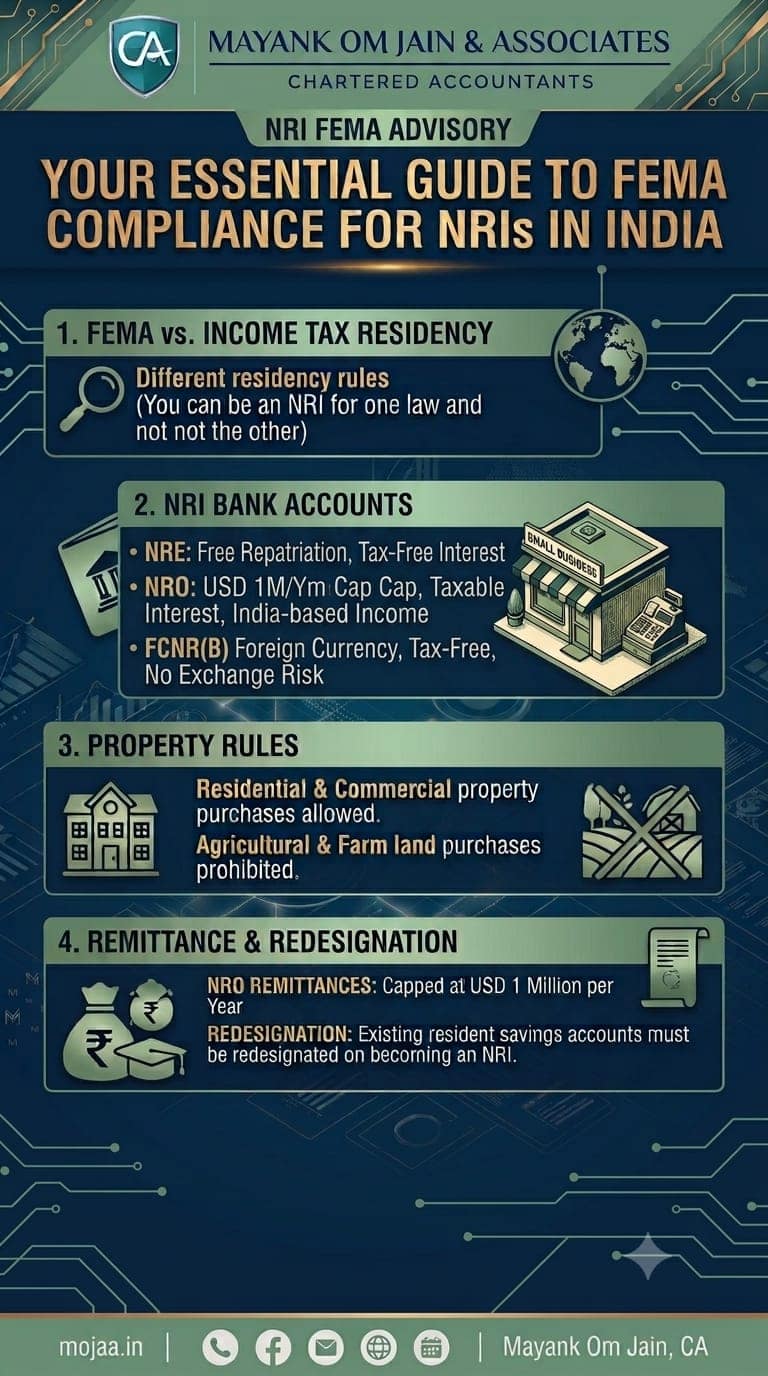
FEMA (the Foreign Exchange Management Act) governs every NRI's bank accounts, property holdings, and cross-border money movement in India, separately from Income Tax residency rules. In practice, this means redesignating accounts to NRE/NRO/FCNR on becoming an NRI, following property restrictions on agricultural land, and repatriating money through the correct route: NRE/FCNR balances freely, NRO balances capped at USD 1 million per financial year with CA certification.
Summary
- FEMA residency and Income Tax residency are determined differently: you can be an NRI under one and still resident under the other in the same year.
- NRE, NRO, and FCNR accounts serve different purposes and follow different repatriation and tax rules; using the wrong one is the most common NRI compliance mistake.
- Money moves out of India through specific, capped routes. NRIs cannot use the Liberalised Remittance Scheme, which is a resident-only facility.
What is FEMA, and how is it different from Income Tax residency rules?
FEMA, the Foreign Exchange Management Act, 1999, governs cross-border transactions: who can hold what, where, and how money can move in and out of India. It is administered separately from the Income Tax Act, and critically, it uses a different test to decide whether you are a "person resident in India."
The Income Tax Act relies primarily on a day-count test, broadly, whether you've spent 182 days or more in India in a financial year, with additional conditions in some cases. FEMA instead looks heavily at intention and purpose: if you leave India for employment, business, or any purpose indicating an intention to stay outside India for an uncertain period, you become a "person resident outside India" under FEMA from that point, often well before you'd cross any day-count threshold. This gap is exactly why someone can be an NRI under FEMA while still being tax-resident in India for that same financial year, or the reverse in a year of return. Each law needs to be checked on its own terms: one does not decide the other.
Which bank accounts can NRIs hold in India: NRE, NRO, or FCNR?
Once you become a person resident outside India under FEMA, you are required to get any existing resident savings account redesignated. The three accounts available serve genuinely different purposes, not interchangeable variants of the same thing.
A rupee account funded from your foreign earnings. Principal and interest are freely repatriable with no cap, and interest is exempt from Indian income tax under Section 10(4)(ii), for as long as your NRI status holds.
A rupee account for income that arises in India: rent, dividends, pension, or interest on India-based investments. Interest is taxable in India with TDS applied. Repatriation of the balance out of India is capped, unlike NRE.
A term deposit held in a foreign currency (USD, GBP, EUR, and others), so there's no exchange rate risk on the deposit itself. Principal and interest are freely repatriable, and interest is exempt from Indian tax.
The account you should be depositing into depends entirely on the source of the money: foreign earnings go to NRE or FCNR, India-sourced income goes to NRO. Depositing India-sourced income into an NRE account is a common and avoidable compliance error.
Can NRIs buy or sell property in India under FEMA?
Yes, with one significant category excluded. NRIs and OCI cardholders can freely acquire residential and commercial immovable property in India. What FEMA does not permit is the purchase of agricultural land, plantation property, or a farmhouse. These can only come to an NRI by inheritance, or with specific RBI permission, never by direct purchase.
On the sale side, an NRI can sell residential or commercial property in India to a resident, another NRI, or (for residential property specifically) a person of Indian origin, without needing prior RBI approval in most ordinary cases. The point that catches people out is repatriation: sale proceeds of residential property can be repatriated abroad for a maximum of two such properties over an NRI's lifetime, and even then only within the broader USD 1 million per financial year repatriation ceiling, with the applicable capital gains tax accounted for.
How much money can an NRI repatriate abroad, and how?
This is where FEMA and the Income Tax Act intersect most directly, and where the routes genuinely differ by account type.
| Source | Repatriation limit | Route / requirement |
|---|---|---|
| NRE or FCNR balance | No cap | Freely repatriable; standard bank KYC applies |
| NRO current income (rent, dividend, pension) | No cap | Freely repatriable after applicable TDS |
| NRO capital balance (incl. property sale proceeds) | USD 1 million / FY | Form 15CA + Form 15CB (CA certification of tax paid) |
| Above USD 1 million / FY | Requires RBI approval | Case-by-case application through your bank |
The single most common misunderstanding here: the Liberalised Remittance Scheme (LRS), which lets resident individuals send up to USD 250,000 abroad per financial year, is not available to NRIs at all. It is a resident-only facility under RBI's own scheme rules. NRIs use the NRO repatriation route instead. This also means the Tax Collected at Source (TCS) rules under Section 206C(1G) (20% above a ₹10 lakh annual threshold for most purposes, lower for education and medical remittances) apply to resident LRS remittances, not to an NRI's NRO repatriation, which instead runs on Form 15CA/15CB tax certification rather than TCS.
Cross-border money movement isn't only a personal-finance question, either. The same Act governs entity-level foreign investment: FC-GPR for shares issued to foreign investors, FC-TRS for share transfers between resident and non-resident holders, filings that sit squarely in FEMA territory alongside an NRI's own remittances. It's the kind of structuring CA Vivek Jain has handled on the M&A and cross-border deal side at the firm, where the same FEMA framework governs both an individual NRI's remittance and a company's foreign investment reporting.
What FEMA compliance mistakes do NRIs make most often?
Four show up repeatedly: continuing to operate a resident savings account after status changes instead of redesignating it to NRO; depositing India-sourced income like rental receipts into an NRE account instead of NRO; assuming the LRS applies to them when it doesn't; and attempting to repatriate property sale proceeds without first securing the Form 15CA/15CB tax certification, which delays the transfer at the bank stage regardless of how clean the underlying transaction is.
Notes on edge cases
- OCI cardholders vs NRIs
- An OCI (Overseas Citizen of India) cardholder is a foreign citizen, not an Indian citizen residing abroad: a legally distinct status from NRI. FEMA extends broadly similar treatment to OCIs for property and banking, but specific investment routes and reporting requirements can differ, so don't assume every NRI rule applies identically to an OCI cardholder without checking.
- Returning NRIs and the RNOR window
- On returning to India permanently, your FEMA status can flip to resident quickly, based on intent, while your Income Tax residency may still qualify for RNOR (Resident but Not Ordinarily Resident) treatment for a limited period. These run on separate clocks: NRE and FCNR accounts need to be converted to resident or RFC (Resident Foreign Currency) accounts within a reasonable period of return under FEMA, regardless of what your RNOR tax status allows on the income side.
- Inherited agricultural land
- NRIs cannot purchase agricultural land, plantation property, or a farmhouse, but they can inherit it, including from another NRI who had lawfully acquired it. Inheritance is a specific, narrow exception to the purchase restriction, not a workaround for buying such property indirectly.
- Gifts to resident relatives
- Using NRO or NRE funds to gift a resident relative is permitted and commonly done, but it needs to be a genuine gift, properly documented, and correctly characterised under Section 56(2) of the Income Tax Act on the recipient's side. Structuring a disguised transfer as a "gift" to sidestep repatriation limits is a red flag, not a workaround.
- Accounts operated by a Power of Attorney holder
- Many NRIs operate their India accounts and property matters through a resident Power of Attorney holder. This is legitimate, but the underlying FEMA and tax obligations remain the NRI's own. A POA holder acting outside the specific mandate, or blending the NRI's funds with their own, creates compliance and documentation problems that surface later, often at the point of repatriation.
Frequently asked questions
Can an NRI keep a regular resident savings account in India?
No. You're required to get resident savings accounts redesignated as NRO on change of status. Continuing to operate a resident account afterward is itself a FEMA violation, regardless of how the funds are used.
Is interest earned on an NRE account taxable in India?
No, it's exempt under Section 10(4)(ii), for as long as you hold NRI status under FEMA. The exemption stops applying once your status changes to resident, even before the account is formally redesignated.
Can an NRI use the Liberalised Remittance Scheme to send money abroad?
No. LRS is only available to resident individuals, up to USD 250,000 per financial year. NRIs use a separate route: NRO balance repatriation, capped at USD 1 million per financial year with CA certification.
How is capital gains tax handled when an NRI sells property in India?
The buyer deducts TDS, typically at a higher rate than for resident sellers, on the full sale value unless a lower or nil TDS certificate is obtained under Section 197 beforehand. Repatriating the proceeds needs Form 15CA and, in most cases, Form 15CB.
What happens to an NRI's existing PPF account after becoming non-resident?
You cannot open a new PPF account as an NRI. Continuation and closure rules for one opened while resident have tightened in recent years. Check the current position with your bank rather than assuming automatic continuation.
Does an NRI need to file an Income Tax Return in India?
Yes, if India-sourced income exceeds the basic exemption threshold, or you have capital gains, rental income, or other India-linked income, regardless of your DTAA position abroad. DTAA reduces double taxation; it doesn't remove the Indian filing obligation.
Sources: Foreign Exchange Management Act, 1999 and RBI Master Directions on Deposits, Remittance of Assets, and Acquisition/Transfer of Immovable Property; Income Tax Act, 1961, Sections 6, 10(4)(ii), 195, 197 and 206C(1G); RBI Liberalised Remittance Scheme guidelines. This article is for general awareness and is not a substitute for advice on your specific situation.