Income Tax · AY 2026-27
ITR Filing Last Date for AY 2026-27: Deadlines and Which ITR Form You Should File
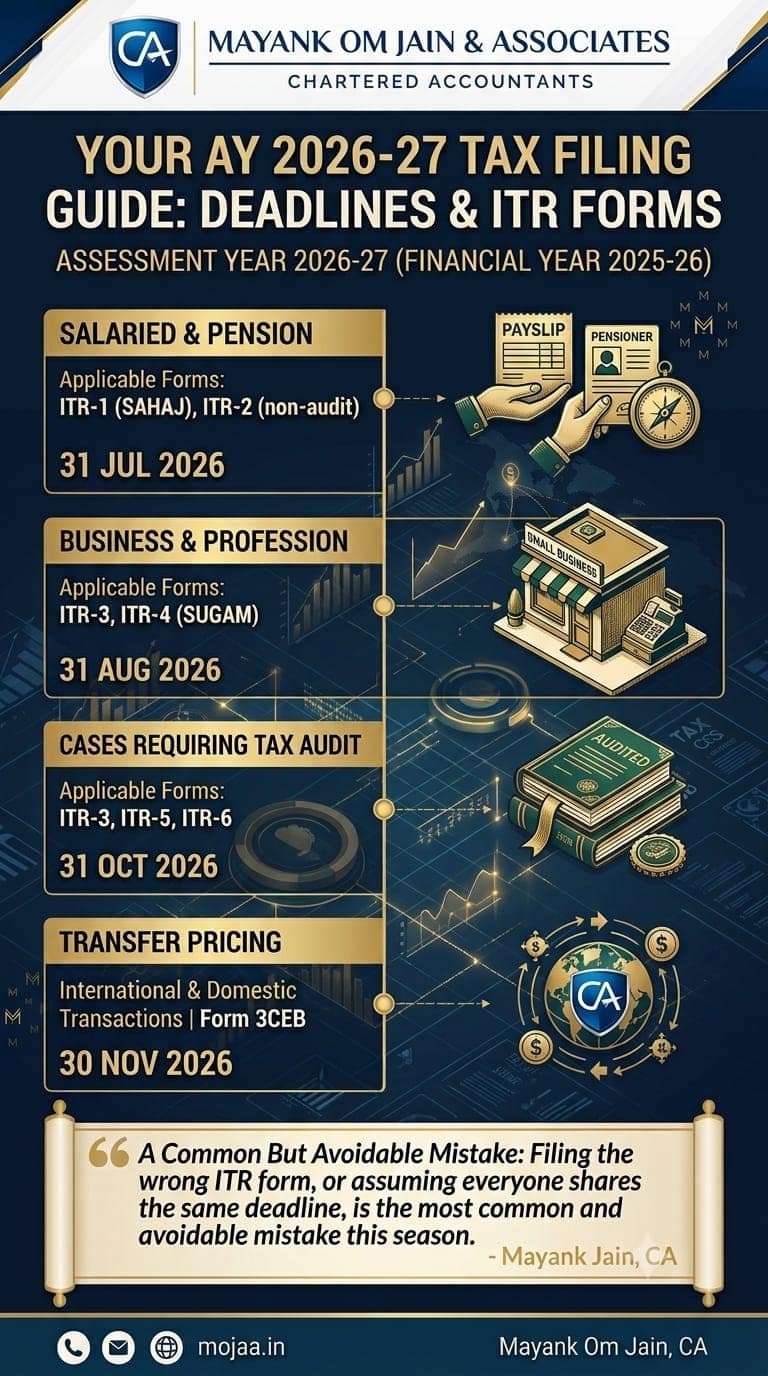
Filing the wrong ITR form, or assuming everyone shares the same deadline, is the most common and most avoidable mistake this season. Here is the complete, verified picture for Assessment Year 2026-27 (Financial Year 2025-26).
Quick answer
For AY 2026-27 (income earned in FY 2025-26), the ITR filing last dates are:
- Salaried, pension, capital gains: ITR-1, ITR-2 (non-audit)31 Jul 2026
- Business / profession, non-audit: ITR-3, ITR-431 Aug 2026
- Cases requiring a tax audit31 Oct 2026
- Transfer pricing: international or specified domestic transactions30 Nov 2026
Your AY 2026-27 return is filed under the existing income tax provisions, because the income relates to the year ending 31 March 2026.
ITR filing deadlines for AY 2026-27
| Taxpayer category | ITR form | Last date |
|---|---|---|
| Salaried, pension, capital gains (non-audit) | ITR-1, ITR-2 | 31 Jul 2026 |
| Business / profession, non-audit | ITR-3, ITR-4 | 31 Aug 2026 |
| Cases requiring a tax audit (incl. companies) | ITR-3, ITR-5, ITR-6 | 31 Oct 2026 |
| Transfer pricing: international / specified domestic transactions | Applicable form | 30 Nov 2026 |
One change worth noting: the due date for ITR-3 and ITR-4 (non-audit business and professional income) is now 31 August, a permanent shift under the Finance Act 2026, not a one-time extension. If your accounts are subject to a tax audit, the audit report (Form 3CA/3CB and 3CD) is due by 30 September 2026, one month before the 31 October return date.
Which ITR form should you file?
Choosing the correct ITR form is the single most important decision before you file. It depends on your sources of income, not your profession or your age.
For a resident individual with total income up to ₹50 lakh from salary or pension, up to two house properties, interest and dividends, long-term capital gains under Section 112A up to ₹1.25 lakh, and agricultural income up to ₹5,000.
For individuals and HUFs with no business income, but with capital gains, foreign assets or foreign income, total income above ₹50 lakh, more than two house properties, or who are company directors or hold unlisted equity shares. Non-residents (NRIs) and RNORs who cannot use ITR-1 typically file here.
For individuals and HUFs with income from business or profession, including income from futures and options (F&O) trading, which is treated as business income.
For a resident individual, HUF or firm (other than an LLP) with total income up to ₹50 lakh and presumptive business or professional income under Sections 44AD, 44ADA or 44AE, subject to the eligibility conditions of those sections.
For firms, LLPs, Associations of Persons (AOPs) and Bodies of Individuals (BOIs).
For companies, other than companies claiming exemption under Section 11 (charitable or religious income). It must be filed electronically.
For trusts, political parties, research institutions and similar entities filing under Sections 139(4A) to 139(4D).
Which ITR forms are live on the e-filing portal now?
As of now, on the Income Tax e-filing portal for AY 2026-27:
- ITR-1, ITR-2 and ITR-4 are fully enabled: online filing, Excel utility and offline utility.
- ITR-3, ITR-5, ITR-6 and ITR-7 have been notified, but their filing utilities have not yet been released.
If your form is ITR-3, you can prepare your return now and file the moment the utility goes live, comfortably before the 31 August deadline.
Belated and revised returns: deadlines and penalties
Belated return: until 31 December 2026
If you miss your original deadline, you can still file a belated return under Section 139(4) until 31 December 2026. Late filing attracts a fee under Section 234F: up to ₹5,000, reduced to ₹1,000 if your total income is below ₹5 lakh. You will also pay interest under Section 234A on any unpaid tax, and you lose the right to carry forward most losses.
Revised return: until 31 March 2027
If you have already filed and need to correct an error, the revised return window under Section 139(5) has been extended to 31 March 2027, new this year. However, if the revised return is filed after 31 December 2026, a fee under Section 234I applies: ₹1,000 where total income is up to ₹5 lakh, and ₹5,000 where it exceeds ₹5 lakh.
Does the new Income Tax Act, 2025 apply to this return?
No, and this causes the most confusion. Your return for AY 2026-27 follows the existing income tax provisions, because it relates to income earned in FY 2025-26 (up to 31 March 2026). Even though the Income Tax Act, 1961 was repealed from 1 April 2026, it continues to govern all filings for AY 2026-27 and earlier years.
The Income Tax Act, 2025 applies from Tax Year 2026-27: the term “Tax Year” replaces the earlier “previous year” and “assessment year.” That is the return you will file next year. It does not change how you file this year’s return.
Frequently asked questions
What is the last date to file ITR for AY 2026-27?
For salaried individuals and others filing ITR-1 or ITR-2 (non-audit), the last date is 31 July 2026. For non-audit business and professional income (ITR-3, ITR-4), it is 31 August 2026. Cases requiring a tax audit are due 31 October 2026.
Which ITR form should a salaried person file for AY 2026-27?
Most salaried individuals with total income up to ₹50 lakh file ITR-1. If you have capital gains, foreign assets, income above ₹50 lakh, more than two house properties, or you are a company director or hold unlisted shares, you file ITR-2.
Which ITR form should a business owner or freelancer file?
File ITR-3 for regular business or professional income, including F&O trading. File ITR-4 if you opt for presumptive taxation under Section 44AD, 44ADA or 44AE and your income is up to ₹50 lakh.
Can I file my ITR after the deadline?
Yes. You can file a belated return until 31 December 2026 under Section 139(4), with a fee under Section 234F of up to ₹5,000 (₹1,000 if income is below ₹5 lakh), plus interest under Section 234A.
Which ITR form does a company or LLP file?
A company files ITR-6 (unless claiming exemption under Section 11). An LLP files ITR-5. Both usually involve a tax audit, with a return due date of 31 October 2026.
Can I revise my ITR for AY 2026-27?
Yes. Under Section 139(5), a revised return for AY 2026-27 can be filed up to 31 March 2027. If it is filed after 31 December 2026, a fee under Section 234I applies: ₹1,000 where total income is up to ₹5 lakh, and ₹5,000 where it exceeds ₹5 lakh.
Sources: Income Tax Department e-filing portal (incometax.gov.in) · Union Budget / Finance Act 2026 · CBDT notifications. This article is for general awareness and is not a substitute for advice on your specific situation.