Fundraising · Startup Compliance
Investors Don't Kill Deals. Dirty Cap Tables Do.
A founder came to us after his Series A collapsed. Strong revenue, strong growth, good product. What killed the round was four days of diligence on a cap table that did not match RoC records.
Quick answer
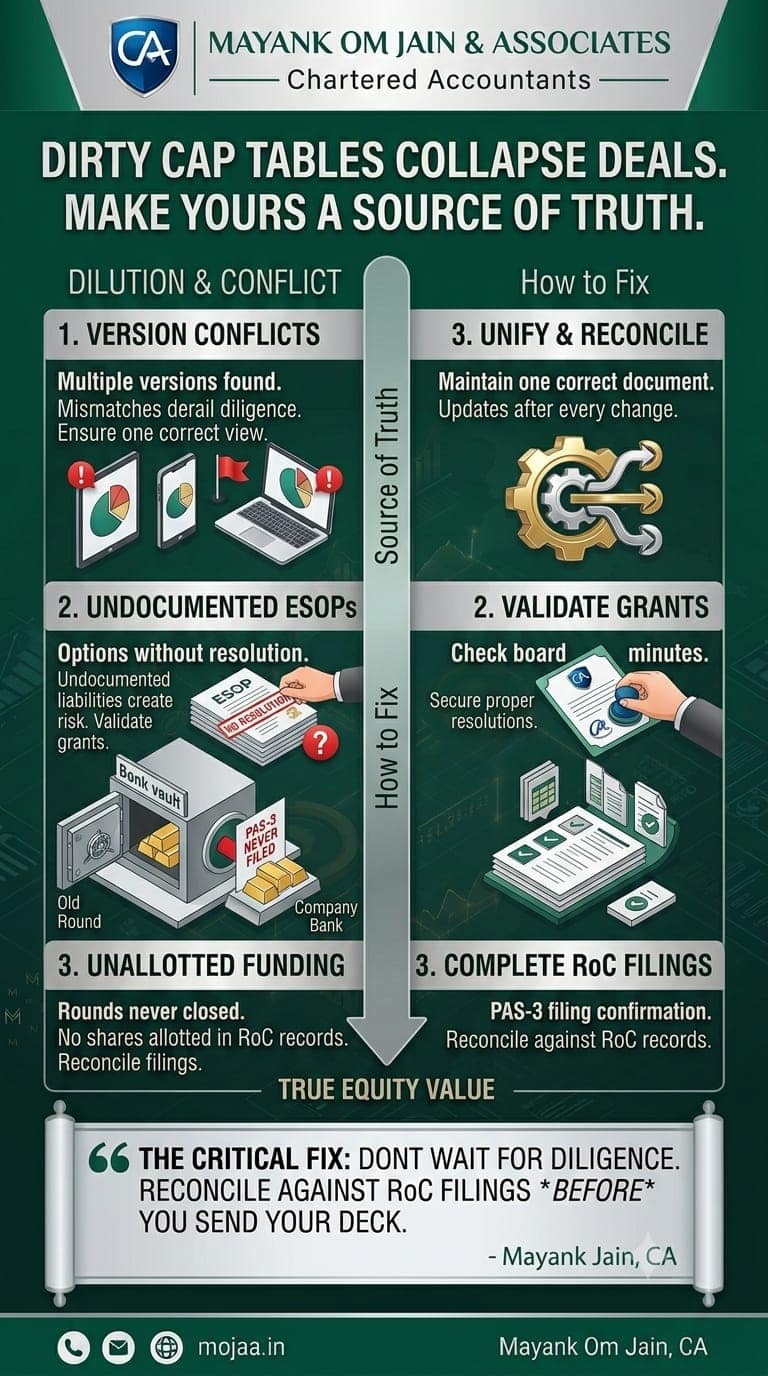
The most common cap table mistakes Indian startups make before a raise are: (1) multiple, conflicting versions of the cap table held by the founder, lawyer, and finance team; (2) ESOP grants issued without a board resolution; and (3) old funding rounds that were never formally closed (money received, but shares never allotted or PAS-3 never filed with the RoC). Any one of these can stall or collapse a round during diligence.
Summary
- Cap tables fail in three predictable ways: version conflicts, undocumented ESOP grants, and rounds that were never formally closed with the RoC.
- None of these show up in a pitch deck. They surface during diligence, when they cost the most: time, leverage, and sometimes the whole round.
- The fix is a single source-of-truth document, updated after every grant, round, and transfer, reconciled against RoC filings before you send your first deck.
Why does a clean cap table matter more than the pitch?
A founder came to us after his Series A fell through. Revenue was ₹3.2 Cr ARR, growing 60% year-on-year, with a team of 14 and a good product. The investor's team spent four days on diligence and found this: the cap table existed in three versions, and none of them matched RoC records. ESOP grants had been made to six employees with zero board resolutions behind them. A seed round from 2022 had never been closed. PAS-3 was never filed. The lead investor walked. The round collapsed. The product was never the problem.
Cap table issues are consistently among the most common reasons a clean-looking deal stalls in diligence, precisely because they surface late, after a founder has already spent months building investor conviction. An investor is not just buying into your business, they are buying a defined ownership stake. If that stake cannot be reconciled against statutory filings, the deal cannot close on schedule, no matter how strong the underlying business is.
What are the three most common cap table mistakes?
The lawyer has one version. The CFO or founder has another. The founder's own memory of who owns what differs from both. When an investor asks for "the cap table," they end up finding all three, and the mismatch itself becomes the red flag, regardless of which version is actually correct.
ESOPs were promised, sometimes even communicated to the employee, but never formally approved. Without a board resolution recording the date, number of options, strike price, and vesting schedule, that grant is not documented equity. It is an undocumented liability sitting on your cap table, waiting to be found.
Money came in from investors, but shares were never formally allotted. PAS-3 was never filed with the Registrar of Companies. On paper, according to the RoC, that round never happened, even though the cash is sitting in the company's bank account and the investor believes they own equity.
How do you build one source of truth for your cap table?
The fix is not a better spreadsheet template. It is a discipline: one document, one owner, updated after every grant, every round, and every transfer, with no parallel copies floating between the founder, the lawyer, and the finance team.
- Every ESOP grant has a board resolution (date, number of options, strike price, and vesting schedule) on paper before the grant is communicated to the employee.
- RoC records match the cap table exactly. PAS-3 is filed within the statutory window after every allotment, and SH-7 is filed whenever authorised capital increases.
- Every round is formally closed: share certificates issued, the shareholders' agreement executed, and stamp duty paid. No gaps between "money received" and "shares allotted."
Notes on edge cases
- Bootstrapped startups raising for the first time
- Even without prior institutional rounds, informal equity promises to co-founders, early employees, or advisors (made verbally or over email, never documented) are the most common first-raise diligence finding. Formalise every existing commitment with board resolutions before you start fundraising conversations, not after a term sheet arrives.
- Convertible notes and SAFEs
- Unconverted notes are a frequent source of cap table drift, since founders often model the round assuming a conversion that has not been formally executed. Until conversion is documented and shares are actually allotted, the noteholder is a creditor, not a shareholder. Your cap table should reflect that distinction precisely, including the conversion trigger and any valuation cap or discount.
- ESOP pool top-ups before a new round
- Investors typically expect the ESOP pool to be topped up pre-money, diluting existing shareholders rather than the incoming investor. If this top-up is not reflected correctly in the cap table before term sheet discussions, the effective valuation and dilution math the founder presents will not match what the investor calculates, a common source of last-minute renegotiation.
- Secondary sales and share transfers
- Any transfer of existing shares between shareholders, not just new issuances, must be reflected in the cap table and filed appropriately. A secondary sale that exists only as a private agreement between two parties, without updating statutory registers, creates the same diligence mismatch as an unclosed primary round.
- Multiple share classes (CCPS, equity, ESOP pool)
- Once a startup has raised via Compulsorily Convertible Preference Shares (CCPS) in addition to equity, the cap table must track conversion ratios, liquidation preferences, and anti-dilution terms per class, not just headline ownership percentages. A cap table that shows only aggregate ownership without class-level detail will not satisfy diligence on a priced round.
Frequently asked questions
How far in advance of a raise should I clean up my cap table?
Before you send the first deck, not during diligence. Once an investor is reviewing your data room, every inconsistency reads as a red flag rather than an admin backlog. Reconciling scattered records typically takes two to four weeks, so start well before you plan to raise.
What documents do investors cross-check against the cap table during diligence?
RoC filings (PAS-3 for allotments, SH-7 for capital increases), board resolutions for every ESOP grant, share certificates, the shareholders' agreement, and the statutory register of members. Any mismatch against these gets flagged.
Do I need a board resolution for every ESOP grant, even small ones?
Yes. Every grant needs a board resolution recording the date, number of options, strike price, and vesting schedule, regardless of size. Without it, the grant is not properly documented equity: it is a future liability.
What is PAS-3 and why does it matter for my cap table?
PAS-3 is the RoC return of allotment, filed after every round in which shares are issued. If it was not filed, your RoC records will not match your cap table, no matter how correct your internal spreadsheet looks.
Can a dirty cap table actually kill a funding round?
Yes. Investors are buying a defined ownership stake. If the cap table cannot be reconciled with statutory filings, the investor cannot confirm what they are acquiring, and lead investors do walk away over exactly this issue.
Who should own the single source-of-truth cap table?
One person or function should own the master document, updated after every grant, round, and transfer, with no parallel copies. In practice this is usually the founder together with a Virtual CFO or company secretary.
Sources: Companies Act, 2013 (Sections 42, 62 and related RoC filing requirements: PAS-3, SH-7); the firm's fundraise-readiness engagement observations. This article is for general awareness and is not a substitute for advice on your specific situation.